
Why is NO ONE Talking About Meta? - Strategies for Investors in the Metaverse Era
Unveiling Meta's Market Mastery 🔍💹: A Comprehensive Exploration into the Metaverse Giant's Stock Performance
Abhishek Jolad
4/1/20245 min read


Business Section of the 10K Form
Meta Platforms, formerly known as Facebook, is focused on building technology to enhance connectivity among people and communities while aiding business growth. They achieve this through developing products accessible via mobile devices, PCs, VR headsets, and wearables. Meta aims to transition its offerings towards immersive experiences, notably augmented reality and virtual reality, as part of their initiative to build the metaverse—seen as the next step in social technology evolution.
Financial Overview
Meta divides its operations into two segments: Family of Apps (FoA) and Reality Labs (RL). The company derives a significant portion of its revenue from advertising sales through the FoA, catering to diverse markets. However, a substantial 82% of their total costs and expenses are directed towards FoA development, while only 18% is allocated to RL development. Notably, the RL segment operates at a loss, a trend that Meta expects to continue. The company's capacity to support metaverse development hinges on its ability to generate profits from other segments of its business.
Meta's shift towards immersive experiences reflects a strategic bet on the future of digital interaction, with the metaverse at its forefront.
Segments
Family of Apps Products
Almost their entire source of revenue and many of Meta’s other areas of business depend on this.
They make money by allowing marketers to purchase ads that can appear in many of their apps.
Their apps include Facebook, Instagram, Messenger, and WhatsApp.
Reality Labs Products
Long-term investment in cutting-edge research and development.
Focus on technologies like neural interface and artificial intelligence.
Current products include Meta Quest VR devices and Ray-Ban Stories smart glasses
Competition
Meta competes with companies in communication services and advertising sales through online services. There are few direct threats while facing competition in virtual and augmented reality products.
Government Regulations
An important factor that we have to consider when evaluating Meta is how they are affected by government regulations. Meta is subject to evolving laws and regulations, including those affecting data privacy and online content. Interpretations of these regulations could impact business operations, revenues, and profits.
Qualitative Analysis
SWOT Analysis
Strengths
Extensive User Base:
Meta boasts a user base encompassing more than 77% of internet users, providing a strong foundation for its operations.
Diverse Product Portfolio:
Meta offers a wide range of products, spanning social media platforms to advertising services, enabling multiple revenue streams.
Advanced Ad Targeting:
The company's social media platforms feature sophisticated ad-targeting capabilities, empowering businesses to reach specific audiences effectively
Weaknesses
Legal Challenges:
Meta faces numerous legal challenges due to government regulations, potentially impeding its ability to generate profits if data flow is restricted.
Reputation Damage:
The company's involvement in privacy scandals has tarnished its reputation, posing challenges to maintaining user trust and loyalty
Opportunities
E-Commerce Expansion:
Meta can leverage its online shops within its Family of Apps to expand into the burgeoning e-commerce industry.
Metaverse Development:
The company's metaverse products hold immense potential, particularly upon public release and profitability.
Threats
Competition:
Rival social media apps pose a substantial competitive threat to Meta, potentially challenging its market dominance and user engagement.
Regulatory Risks:
New privacy regulations and government restrictions may significantly impact Meta's revenue-generating capabilities.
Fundamental Analysis
Income Statement
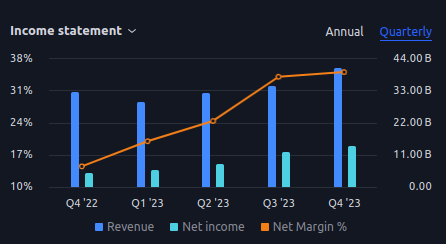
Revenue and Net Income:
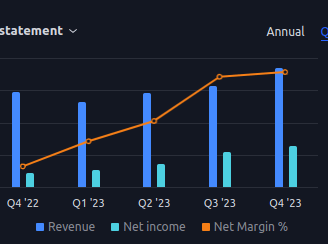
Revenue increased by 15.7% in fiscal year 2023.
Net income rose by 68.5% compared to the previous fiscal year.
R&D Spending:
R&D spending saw a significant slowdown, with a percent increase of only 8.9% from 2022 to 2023, compared to 43.3% from 2021 to 2022.
This drop in spending raises questions about Meta's commitment to the Metaverse initiative.
Sales and Marketing Costs:
Costs dropped by 19.4%, indicating positive progress.
The income statement analysis reveals robust growth in both revenue and net income for Meta, indicating strong performance and increasing profitability. However, the significant slowdown in research and development (R&D) spending, coupled with a decrease in sales and marketing costs, suggests a strategic shift in focus and operational efficiency within the company.
Balance sheet
Total Assets:
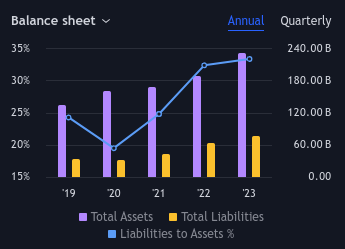
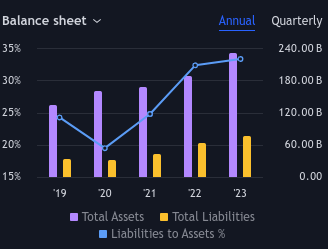
Total assets grew approximately 23.6%.
Total Liabilities:
Total liabilities increased by 27.4%.
Return on Assets (ROA):
ROA stands at 18.83%, indicating efficient utilization of assets to generate profit.
Return on Equity (ROE):
ROE is relatively higher than ROA, suggesting possible excess debt.
Price-to-Book Ratio (P/B):
Meta's P/B ratio of 8.12 may indicate overvaluation, though industry comparison shows relative alignment with the average of 11.03.
The balance sheet analysis indicates significant growth in total assets, reflecting expansion and investment in operations, while a higher return on equity (ROE) compared to return on assets (ROA) suggests possible reliance on debt financing. Additionally, a notable increase in total liabilities raises concerns about leverage and its impact on financial stability.
Cash Flow Statement
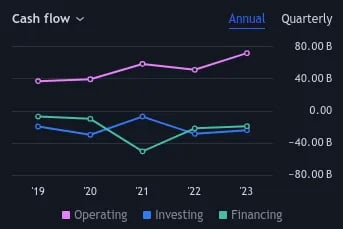
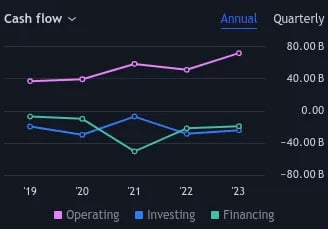
Operating Activities:
Net cash from operating activities increased by 40.9% from 2022 to 2023, reflecting improved efficiency and profitability.
Investing Activities:
Spending decreased slightly from 2022 to 2023, but notably increased over 300% from 2021 to 2022, suggesting a shift in investment priorities.
Cash and Cash Equivalents:
Increased by a significant 174.6% during fiscal year 2023, indicating stability but also potential conservatism in spending.
Meta's cash flow statement indicates a notable increase in net cash from operating activities, showcasing improved efficiency and profitability in core business operations. However, shifts in investment priorities are evident, with decreased spending in some areas but a substantial increase in cash and cash equivalents, highlighting both stability and potential conservatism in spending.
Financial Ratios
Valuation (Price):
Price-to-Earnings (P/E) Ratio:
32.60
Interpretation: As the industry average for the P/E ratio is 52.35, a P/E ratio of 32.6 may indicate that Meta is undervalued.
Profitability:
Return on Equity (ROE):
28.04%
Interpretation: Reflects a high level of profitability and demonstrates that Meta is effectively utilizing shareholder equity to generate profits
Liquidity:
Current Ratio:
2.67
Interpretation: Meta has a strong liquidity position and is well-equipped to cover its short-term liabilities with its short-term assets
Debt (Solvency):
Debt-to-Equity Ratio:
0.25
Interpretation: Meta has greater financial stability and can handle poorer macroeconomic conditions without facing significant setbacks.
Asset Turnover Ratio:
0.59
Interpretation: Implies that the company is not effectively leveraging its assets to drive sales and profitability. However, the industry average is 0.41 which Meta has a competitive advantage over others.
Intrinsic Value and Target Valuation Price:
The intrinsic value of Meta's stock is estimated to be $350 per share. Based on our target valuation metrics and market factors, the target valuation price range of $520 to $550 per share. This valuation takes into account Meta's financial performance, growth prospects, industry comparables, and market sentiment.
Technical Analysis
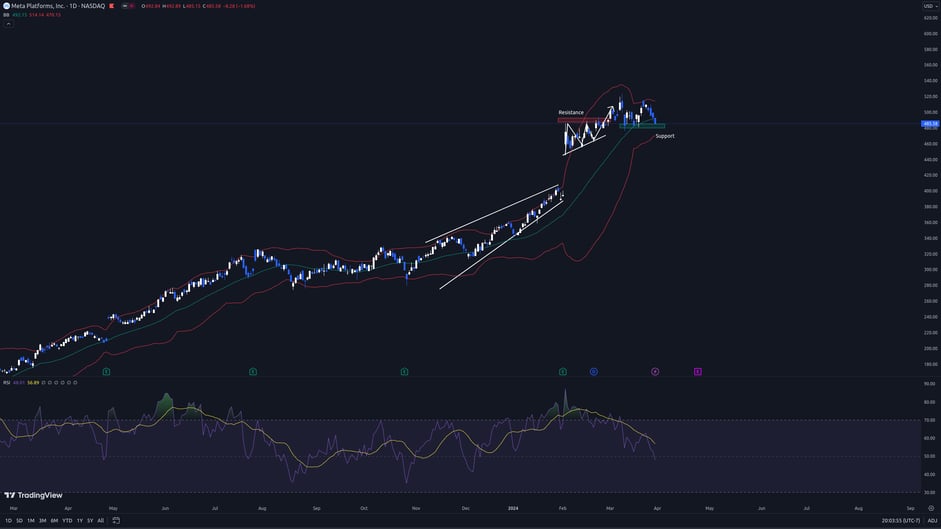
Resistance at around $490 could lead to a breakout because of the ascending triangle pattern.
After the breakout, the price returned to a new support
Based on the indicators, the price is below the moving average of the Bollinger Bands while the RSI indicator shows that investors are selling too quickly
Because of the support level and BB + RSI indicators, the price will likely bounce back up in the short term. This could be a potential buying point.